- This event has passed.
Overview
Thursday July 24, 2025 at 7:00pm
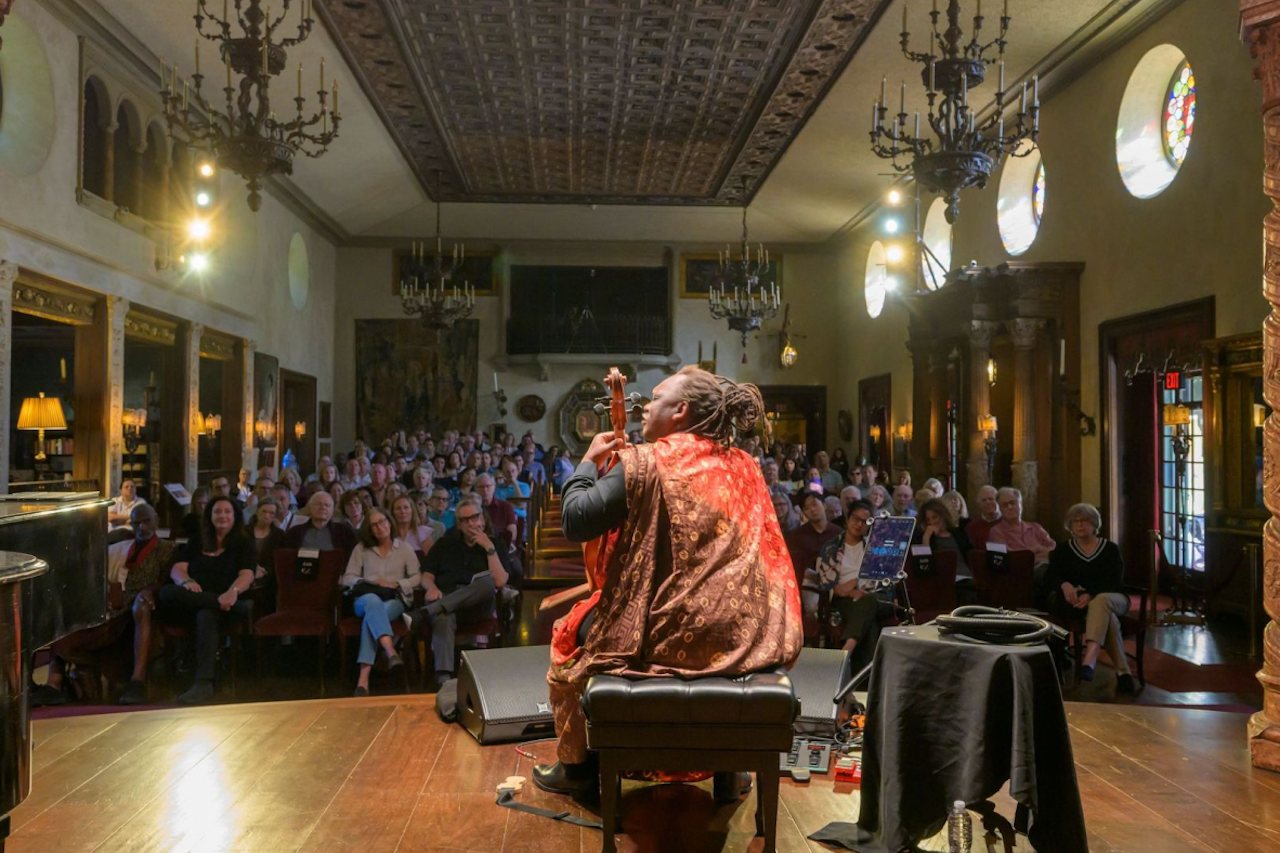
Please note: due to forecasted extreme heat, this concert has been moved to the Music Room at the Rosen House.
Program
Robert Schumann: Canonic Etudes op. 56 (arr. Timo Andres)
Timo Andres: It takes a long time to become a good composer
Aaron Copland: Piano Sonata
A Note about the Program from Timo Andres
When I’m working to understand a piece of music, I find it helpful to think about its balance of complexity versus simplicity—which aspects operate on which levels, how do they relate to each other, how do they define the piece’s language and structure? My favorite pieces are usually a calculated mix of the two, rather than being all to one side or the other. This dialectic might be a useful way to approach tonight’s program, whose contents might, at first glance, seem only tangentially related.
Robert Schumann’s music is usually associated with a kind of hyper-Romantic emotional complexity, hinging on dramatic contrasts, idiosyncratic forms, and dense webs of personal and literary references. I’ve long admired his Canonic Etudes, in part because they play against these stereotypes so strongly. Composed originally for the Pedalflügel, a special piano fitted with an organ-like foot-operated keyboard connected to the bass register, the Etudes are beautifully understated studies in the contrapuntal possibilities enabled by two extra appendages (they are most often heard today in their four-hand or two-piano arrangements). All six etudes are, in fact, perfect canons, with the canonic voice sometimes at the unison and sometimes at the fifth, for a more fugal effect. Schumann’s steadfast commitment to counterpoint sometimes results in unexpected harmonic twists, yet the music never feels haphazard or underworked. Just beneath the wild Romanticism, Schumann turns out to have been every bit as rigorous a technician as Bach or Brahms; it’s just that he usually chose to emphasize the complexity of other aspects of his music. In the Canonic Etudes, he knew to keep the rhetoric simple: all are short, A-B-A forms with clearly-delineated and traditionally-phrased melodies and neatly resolved endings, relating to each other in shared attitude and compositional process, rather than any sort of overarching drama or shared themes.
When I composed the suite It takes a long time to become a good composer in 2010, I was thinking about Schumann. The piece is an attempt to fuse some of Schumann’s more radical structural ideas (the telescoping, nesting doll forms of pieces like Carnaval and Kreisleriana) with a pared-down, anti-virtuosic piano language derived from Copland and Stravinsky. The resulting music is, in some ways, less committed to structural rigor than anything I’ve written. I didn’t compose it with an overall through-line or process in mind. Instead, its developmental engine comes from its odd cocktail of jump-cuts and stylistic references jostling against each other. The core of the piece is its long central movement, Everything is an onion, which gradually surrounds a somber passacaglia with buzzing activity before dismantling it (fittingly) into layers. As the piece progresses, it moves generally from the idea of music as “material”—small, abstract chunks of harmony, texture, or figurations—to music as melody, and, finally, song. The effect is a gradual de-tensioning of the structure, a progressively freer interrelation of materials, like falling asleep directly into a strange dream.
It’s been remarked that the Piano Sonata represents Copland at his sparest, most severe, most aspiringly “modernist”; its language is all planes and angles, harmonies stripped to their essence, ornament eliminated. The sense of “placeness” associated with Copland’s music is absent here, or perhaps it places itself in an imaginary realm halfway between the American West and a 1920s Paris salon. The musical texture is notable for its absence of counterpoint, instead often focusing on unadorned melodic lines. Chords seem as though they have big chunks of missing notes, the yawning gaps between their intervals creating startling and uncomfortable dissonances. Tempos change frequently, and phrases fill uneven numbers of bars, cutting each other off without warning. Essentially, Copland has found the reverse balance of complexity and simplicity of Schumann’s; the richness of his Sonata lies in the contrast of its surface and its rhetoric. It communicates complex ideas in admirably clear language. The effect is dramatic, almost in a theatrical sense as if musical material were playing different characters (perhaps it’s not coincidental that the piece is dedicated to the playwright Clifford Odets). Sometimes the music is a dialogue, as it is between the right hand and the left in the second movement, and other times a monologue, in the long, discursive, ultimately tragic arias of the third. In the end, we feel as if we’ve absorbed a story much grander than the piece’s 23 minutes could possibly contain, full of vivid settings, plot twists, intersecting character arcs, and sharply-observed details.
About Timo Andres
Timo Andres is a composer and pianist who grew up in rural Connecticut and lives in Brooklyn, NY.
Recent highlights have included a solo recital debut for Carnegie Hall and the world premiere of a piano concerto for Aaron Diehl at the Los Angeles Philharmonic, led by John Adams. Andres’s orchestrations and arrangements for Justin Peck’s 2024 production of Sufjan Stevens’s Illinoise completed an acclaimed limited run on Broadway at the St. James Theater following sold-out runs at The Fisher Center at Bard, the Chicago Shakespeare Theater, and at New York City’s Park Avenue Armory. For his work on the production, Andres was nominated for 2024 Tony Award for Best Orchestrations.
In 24–25, Timo Andres performs at Stanford Live with Conor Hanick, and at the Phillips Collection with Aaron Diehl. He also reunites with the Calder Quartet to perform his new piano quintet The Great Span in New York City for the People’s Symphony.
Andres continues with performances of Philip Glass’s Piano Etudes internationally; he is a trusted collaborator of Philip Glass, serving as advisor and editor of a 2023 edition of the Etudes published by Artisan. Andres performed these works last season at Lincoln Center, the Chicago Humanities Festival, the Music Academy of the West, for NPR’s Tiny Desk Concerts, and elsewhere.
Notable works include Everything Happens So Much for the Boston Symphony; Strong Language for the Takács Quartet, commissioned by Carnegie Hall and the Shriver Hall Concert Series; Steady Hand, a two-piano concerto commissioned by the Britten Sinfonia premiered at the Barbican by Andres and David Kaplan; and The Blind Banister, a concerto for Jonathan Biss, which was a 2016 Pulitzer Prize Finalist.
As a pianist, Timo Andres has appeared with the LA Phil, North Carolina Symphony, the Albany Symphony, the New World Symphony, the Metropolis Ensemble, among others. He has performed solo recitals for Lincoln Center, and Wigmore Hall. Timo’s collaborators include Becca Stevens, Jeffrey Kahane, Gabriel Kahane, Brad Mehldau, Nadia Sirota, and—of course—Philip Glass, who selected Andres as the recipient of the City of Toronto Glenn Gould Protégé Prize. He was nominated for a Grammy award for his performances on 2021’s The Arching Path, an album of music by Christopher Cerrone. Andres’s collaborations with Sufjan Stevens also include his May 2023 recording with Conor Hanick of Stevens’s latest album, Reflections; arrangements of ballets for New York City Ballet, and a solo piano album, The Decalogue.
A Nonesuch Records artist, Andres has multiple albums on the label, including 2024’s The Blind Banister with Metropolis Ensemble. A Yale School of Music graduate, he is a Yamaha/Bösendorfer Artist and is on the composition faculty at the Mannes School of Music at the New School. He was recently awarded the 2025 Stoeger Prize by the Chamber Music Society of Lincoln Center.
Know Before You Go
Summer Season Shuttle / Take the FREE shuttle from Metro North’s Katonah train station to and from Caramoor! The shuttle runs before and after every summer afternoon and evening concert. There is no RSVP to get on the shuttle, it will be there when you arrive (in the parking lot side of the station). If it’s not there, it’s just making the loop and should be back within 5–10 minutes. The shuttle will start running 2.5 hours before the concert, and 30 minutes after the concert ends.
Rain or Shine / All events at Caramoor take place rain or shine. In the event of bad weather, this Spanish Courtyard concert will move under the Venetian Theater tent (with open-air sides) or into the Music Room (fully indoors).
Make the Most of Your Time at Caramoor
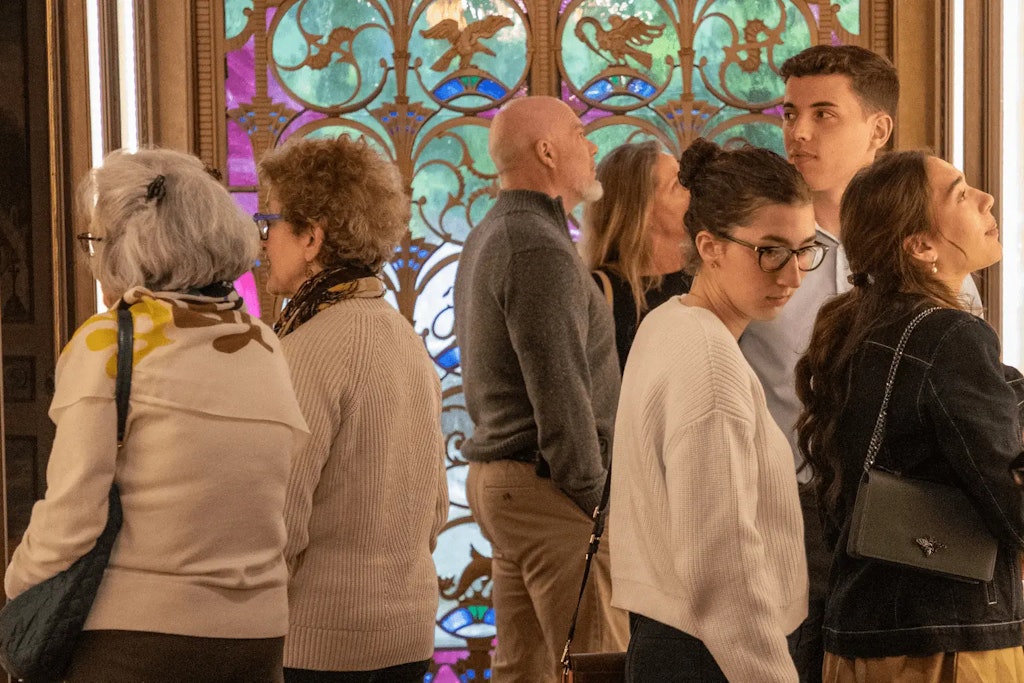
Explore the Rosen House / Select rooms of the Rosen House are free to explore during our Open House hours. No RSVP is required; feel free to attend and discover more about Caramoor’s history and founders.