Echoes in the Music Room: Timo Andres, Aaron Copland, and the Caramoor WW II Focus
By Tara Duffy
By Laura Sanzel
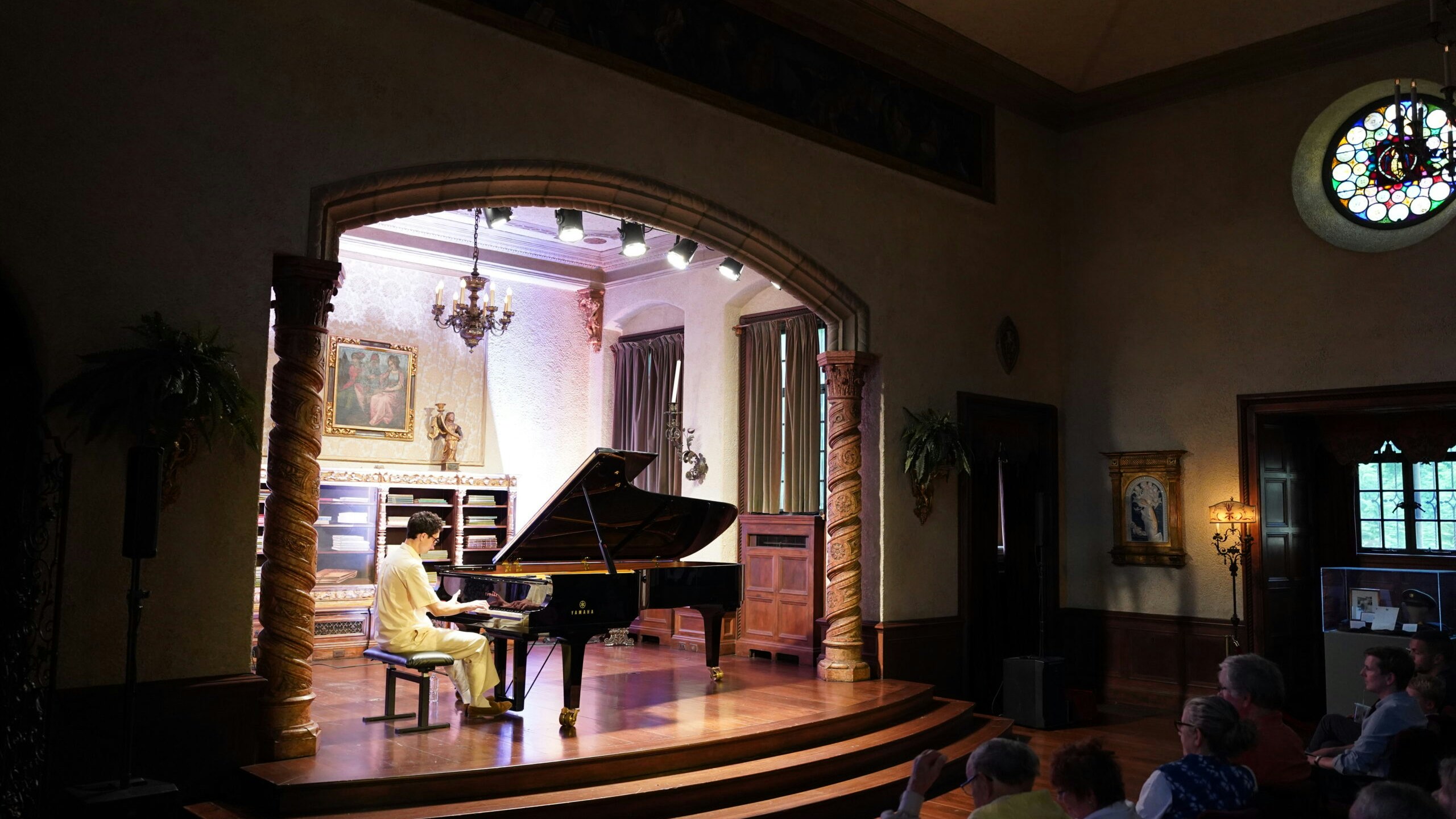
On July 24, I attended a concert in the Music Room at the Rosen House featuring pianist and composer Timo Andres. I was especially drawn by the chance to hear Aaron Copland’s rarely performed Piano Sonata (1939–41). The program offered several other compelling works, including Andres’ own composition It takes a long time to be a good composer (2010). He closed the evening with another of his pieces—Fiddlehead (2023)—a spectacular encore that was complex and engaging and very much appreciated by the audience.
This season the Rosen House Focus Tour is centered on World War II and its impact on Caramoor and the Rosen family. It tells a heartbreaking story about loss, generosity, and the American spirit, and I was eager to see if I could hear echoes of those themes in Copland’s Sonata. The work—written in the early years of the war—is spare and at times unsettled, and in it I heard something of the era’s deep uncertainty as well as its resilience.
As the Grants Administrator for Caramoor, I am aware that funding from the Aaron Copland Fund for Music helps make it possible for Caramoor to present concerts featuring American contemporary concert music—which we include in our programs on a regular basis. That connection was very much on my mind as I sat in the Music Room, listening to Andres perform.
As he played It takes a long time to be a good composer—a suite whose title offers a quiet reminder that artistry demands both patience and trust—I couldn’t help thinking of a letter that Jessa Krick, Caramoor’s Director of Interpretation, Collection, and Archives for the Rosen House, had recently shared with me. It was from Aaron Copland himself, written to Lucie Rosen.
Lucie had written to Copland after hearing his “chorus,” which, after a little research, I believe refers to a May 2, 1947 performance of In the Beginning, conducted by Robert Shaw and sung by the Collegiate Chorale at Harvard Memorial Church. In his response to Lucie, Copland wrote:
“A composer thinks he knows what he puts into his composition but, isn't sure until he gets such letters as yours.”

That line has stayed with me. It speaks to the quiet vulnerability of every composer—to the leap of faith it takes to write music and release it into the world. I thought of that as Andres stood to receive the audience’s standing ovation. Perhaps that moment—standing in the Rosen House was its own kind of letter back to a composer, affirming that the music mattered, that it was heard.
Caramoor continues to be a place where these threads meet: past and present, legacy and innovation, audience and artist. And thanks to supporters like the Copland Fund, we are able to carry that conversation forward—one performance at a time.