
March 3, 2026
I overslept today, which meant two things: I felt a bit better than I had yesterday (at least until I began to crash at around 3:30), and we got off to a late start. Béné and I walked in to find Luis at the piano working on the Tchaikovsky duet, a lovely waltz based on a Ukrainian folk tune. The poem describes a weeping woman, seated by a river, of course (that’s why she got invited to our party)—observed by a gentleman who seems not to give a rat’s behind about her sadness. There are many ways to think about this piece. It could be based around Tchaikovsky’s life around the time of its composition. (Tchaikovsky had an intense aversion to the neurotic woman he married, a kind of live-in beard to deflect rumors of his homosexuality. It didn’t end well.)
But it’s simpler, perhaps, to remember that the composer wrote his suite of vocal duets for his family to sing, and that the graceful music was meant to flatter the voices of his two sisters, accomplished amateur musicians. In any case, Luis had made tremendous strides since his first reading yesterday, and the waltz now sported pink ballet slippers, not imposing black boots. The girls still seemed to be picking their way through the very syllabic vocal line, a mountain of Russian consonants and thick-tongued consonants. We urged them to put the song in the diction blender and liquefy the chunky texts, and things seemed to improve.
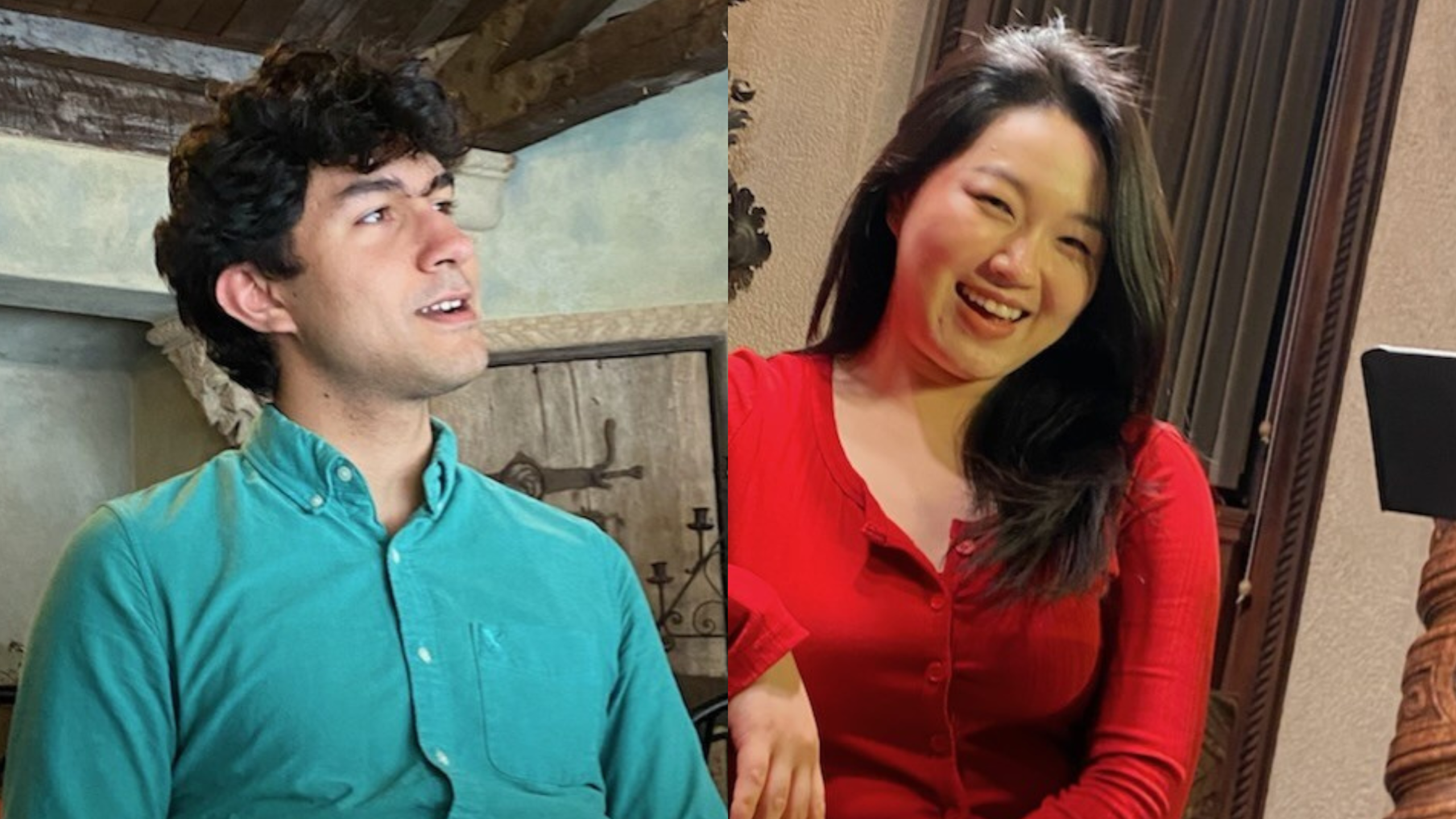
Everyone had a special moment today, but the one that stuck with me the most took place with soprano Shiyu Zhuo. I had assigned her a dramatic song by Joaquín Turina called “Olas gigantes,” whose declamatory vocal lines go head to head with a turbulent piano part. Shiyu has a light, agile voice—there’s plenty of substance in her sound, but at this point she’s geared more to sweetness and ecstasy than songs about a woman courting self-destruction in a raging, ravenous ocean—like “Olas gigantes.”
Her first reading was confident and solid, but maybe a trifle thin for the needs of the music. Was there more sound there, and could I get to it safely without asking her to push or scream? I resorted to a technique I use every once in a while for such purposes: I asked her to sing the first two phrases of “Vissi d’arte,” from Puccini’s Tosca. They are slow and lyrical, nothing that would hurt a young singer, but the role belongs to heavier, more mature artists. That’s the sound any soprano would have in her ear, whether or not she had it in her throat. “Go ahead, give me full diva, Shiyu. Just the first two phrases.” “Callas!” she cried. “Callas,” I affirmed.
She began to sing, and there were two notable things. One, she knew the aria (you’d be amazed how many slender-voiced coloraturas can whip out the beginning of “Vissi d’arte” when asked). Two: she tapped into the full expanse of her voice, a sound of greater depth and amplitude than she or I had ever heard emerge from her body. She looked at me in amazement. “Oh. My. God.”
“OK. Stay right there, and sing the Turina song again.” Suddenly the fire blazed up—not just more voice but more incisive rhythm, more emotional abandon, more character. At the end of the song there are two phrases with soft high notes, and there the difference was even more marked. They had an unearthly glow and so much resonance--floated sounds that filled the room with light.
Through it all Luis was turning his piano into an orchestra. I’d given him a few notes at the beginning of the session (flipping around some dynamics, moving a crescendo over by a couple of bars, and inserting an imperceptive accelerando before the vocal entrance). Those changes seemed to have brought not just the piano intro to life, but the entire piece. Luis is somewhat new to vocal accompaniment—most of his work with has been with instrumentalists. They tend to be more abstract as a group, and they plan much of their music-making in advance. By contast, song is drama, song is theater, song is character, song is poetry. Even a simple accompaniment pattern can be a springboard for something unexpectedly vivid. And singers are more unpredictable, in the moment, than most instrumentalists. It’s been wonderful to watch Luis go from an accomplished abstract musician to a colorful purveyor of musical fire.