Caramoor Launches Free Digital Guide on Bloomberg Connects
By Caramoor Center for Music and the Arts
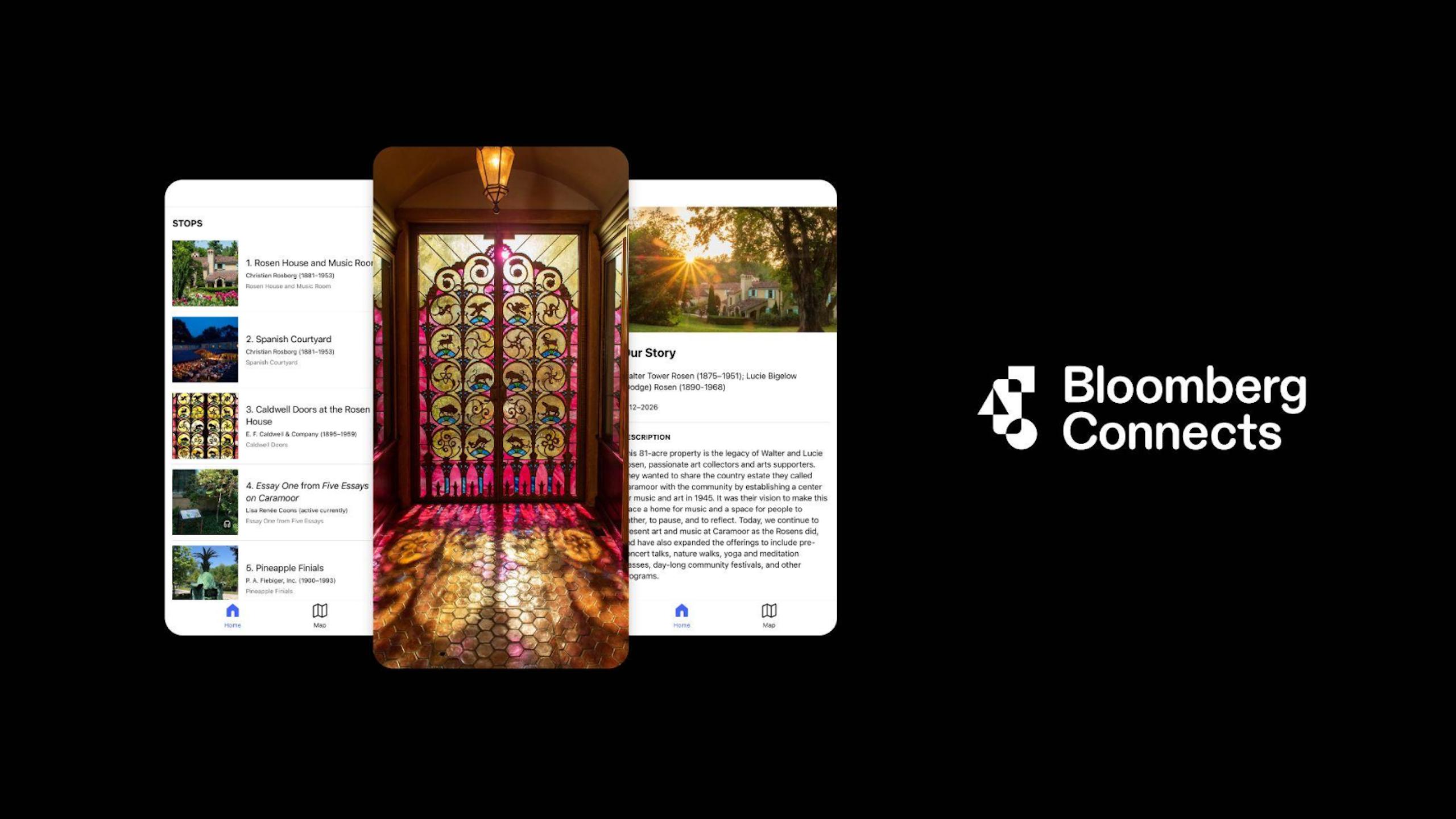
Caramoor has launched its official digital guide on Bloomberg Connects, the free arts and culture app from Bloomberg Philanthropies. The guide invites visitors to explore Caramoor's 81-acre estate in Westchester County at their own pace, with a 23-stop, one-mile walking tour of the gardens, architecture, and outdoor performance venues that have defined the property since Walter and Lucie Rosen opened it to the public in 1946. Because Caramoor's grounds are free and open to the public daily, any visitor can now walk the estate with expert commentary in hand: no ticket, no guide, no admission fee. The guide is available in multiple languages and was made possible through the support of Bloomberg Philanthropies.
The Caramoor guide is available now on Bloomberg Connects, a free digital guide to cultural organizations around the world. It can be downloaded from the Apple App Store or Google Play Store and viewed online at guides.bloombergconnects.org. The app requires no ticket, login, or subscription. Caramoor's gardens and grounds are free and open to the public every day from 10:00am to 4:00pm, unless otherwise noted. Visitors can walk the entire tour without a ticket or reservation.
At the center of the guide is Caramoor's Gardens and Grounds, a self-guided tour of roughly 90 minutes that traces a one-mile loop across the estate. Stops include the Pegasus Gates by sculptor Malvina Hoffman, the open-air Venetian Theater designed by Frederick Kiesler, the Spanish Courtyard and Italian Pavilion by Christian Rosborg, the Sunken Garden and Tapestry Hedge laid out by landscape designer Flora MacDonald Potter, and Friends Field and Stage by Beyer Blinder Belle Architects with Avant Garden Designs. Along the way, visitors encounter the Dovecote and Marjorie Carr Adams Sense Circle, the Woodland Garden, and the bronze Caldwell doors that once hung in the Rosens' New York townhouse. The tour also introduces five permanent sound art installations sited across the grounds: Dyning in the Dovecote by Liz Phillips, t(ch)ime by Taylor Deupree, Wild Energy by Annea Lockwood and Bob Bielecki, in "C" by Trimpin, and Stone Song by Ranjit Bhatnagar.
The guide's second tour, Five Essays on Caramoor, a Sound Walk, is a five-stop, hour-long audio and visual work by artist Lisa Renée Coons. Created for the estate, the piece moves across the grounds through a sequence of essays that draw on Caramoor's history, its landscape, and the archival record, pairing Coons's compositions with collaged visual scores installed on site.
Throughout the guide, eighteen audio clips bring Caramoor's history and its people into the visitor's ear. Among them is an excerpt from a 1962 broadcast of the television program Camera Three, in which Lucie Rosen welcomes host James Macandrew to Caramoor and describes how music became central to the family's life. Anne Bigelow Stern, the Rosens' daughter, recalls the Italian-American gardeners who tended the estate's grounds. Caramoor trustee David Pogue explains what makes the Italian Pavilion noteworthy; Floy Kaminski, chair of the Rosen House Committee, discusses the Caldwell doors; and artists Liz Phillips and Taylor Deupree describe the thinking behind their installations. Lisa Renée Coons introduces the sound walk in her own voice.
A Welcome to Caramoor section orients first-time visitors with a message from President and CEO Gillian Fox, a short history of the institution, and a profile of Walter and Lucie Rosen. The art collectors and music patrons built a Mediterranean-style country house between 1929 and 1939. Now listed on the National Register of Historic Places, it anchors the estate and remains a stop on the walking tour.
The guide also includes a detailed Accessibility at Caramoor section covering parking, complimentary wheelchairs, restrooms, service animals, and pathway surfaces across the grounds. It also maps Caramoor's wellness and sensory-friendly space, a quiet room with rocking chairs, children's books, and a changing table where guests can rest, take a break from live music, or nurse in privacy. Caramoor's accessibility work has been supported by Floy and Amos Kaminski and Nicole and Gerald Mayer.
Every audio clip in the guide is accompanied by a full text transcript. Content can be used on site while walking the grounds or explored remotely from anywhere.