
Many thanks to guest contributor, docent Randy Hans, for this post about John Bigelow Dodge (1894 – 1960), Lucie Rosen’s brother.
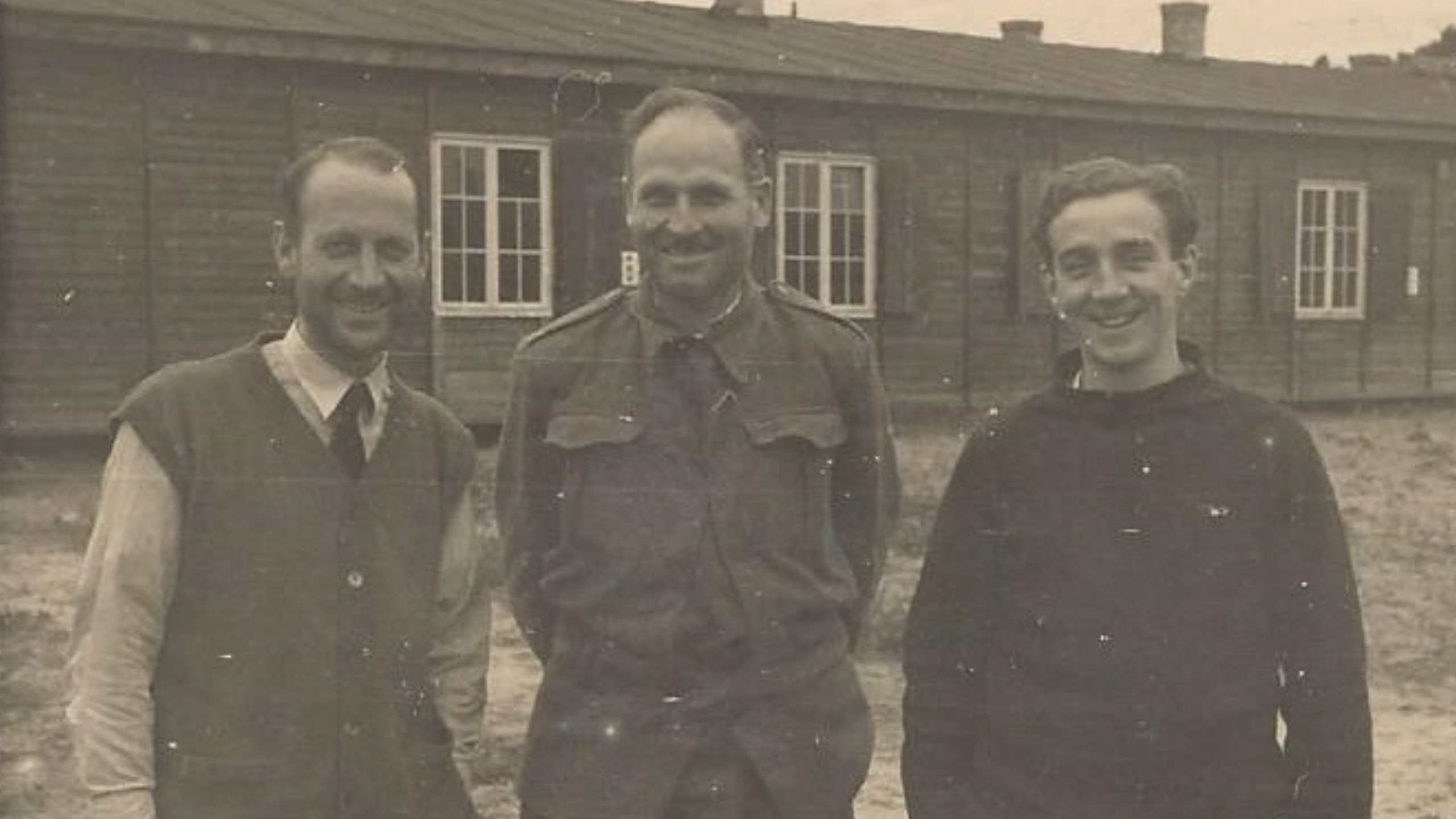
If you tour the Rosen House during this summer’s Focus Tour, Caramoor & World War II, you may notice a framed black-and-white photo on the nightstand in the Monkey Bedroom. If you look quickly at the photo (shown below), you see a trio of smiling men, perhaps at a campground or hunting lodge. If you look more closely, you will see that the man in the middle is wearing a military jacket.
That man is Lucie Rosen’s brother, John “Johnny” Dodge, pictured during his imprisonment in World War II at Dalag Luft, a prisoner-of-war camp in Germany. The other two men and the photographer are not identified. The story of this photo begins many years before it was created, and the smiles of the men belie their wartime circumstances.
When Lucie and Johnny’s mother, Flora, divorced their father, Charles Dodge, and married The Honorable Lionel Guest in 1905, the family moved to Montreal, Canada (where Lionel Guest was living at the time), and later to London. Lionel was a British noble, a cousin of Winston Churchill, the fourth son of Ivor Bertie Guest, 1st Baron Wimborne. Among the wealthiest families in Britain, the Guests’ fortune derived from iron and steel. Unlike Lucie, who always considered herself an American, Johnny became a naturalized British citizen.
In 1913, Johnny – back in New York – worked for Ladenburg-Thalmann, Walter Rosen’s investment bank. He invited Walter to a party at his family’s summer home on Isle St. Gilles (in Senneville, on the western end of the island of Montreal), where Walter became reacquainted with Lucie and, ultimately, wed her that August.
Johnny was a commissioned Naval officer in World War I, earning the Royal Navy’s Distinguished Service Cross.
After World War I, he visited Southeast Asia and countries bordering Russia, opening offices for his trading company in the Caucasus. Suspected of spying for MI6, he was expelled by the Georgian authorities. He became a partner at Nathan & Roselli, a London investment firm. In 1929, he married Minerva Arrington, a divorced Southern belle with a son, Peter, and fathered two more children with her, David and Lionel. He represented the Mile End district on the London County Council from 1925 – 1931.
During World War II, Johnny received an Army officer’s commission. In June 1940 he was captured in France, and spent most of the remainder of the war in a series of German POW camps. Due to his family connections, he was “reclassified” as an officer of the British Royal Air Force, which assured him better treatment than he would have received as an Army officer. He became known as “The Dodger” for his frequent escape attempts, most notably that which became the subject of the 1963 film, “The Great Escape,” starring Paul Newman. The Rosen House archives are fortunate to have a number of wartime letters from Johnny to Lucie and Walter, some of which are featured in the Focus Tour.
To learn more about Johnny’s life and times, read The Dodger by Tim Carroll (Globe Pequot Press, 2013.)